
IUPAC Nomenclature of Coordination Compounds
Naming coordination compounds requires a specific set of IUPAC rules. Mastering the order of cations, anions, and ligands—along with special naming conventions for metals in anionic complexes—is crucial for JEE and NEET.
1. The Golden Rules of Ordering
The name of a coordination compound is constructed in a specific sequence, similar to naming simple salts (Cation first, then Anion).
2. Naming Ligands
Ligands are named first within the coordination sphere. They are listed in alphabetical order, regardless of charge.
Ligand Suffix Rules
- Neutral Ligands: Usually same as molecule name.
Exceptions: $\text{H}_2\text{O}$ (Aqua), $\text{NH}_3$ (Ammine), $\text{CO}$ (Carbonyl), $\text{NO}$ (Nitrosyl). - Anionic Ligands: End in 'o'.
$\text{Cl}^-$ (Chlorido/Chloro), $\text{CN}^-$ (Cyanido/Cyano), $\text{OH}^-$ (Hydroxido/Hydroxo), $\text{C}_2\text{O}_4^{2-}$ (Oxalato). - Cationic Ligands: End in 'ium'.
$\text{NO}^+$ (Nitrosonium), $\text{NH}_2\text{NH}_3^+$ (Hydrazinium).
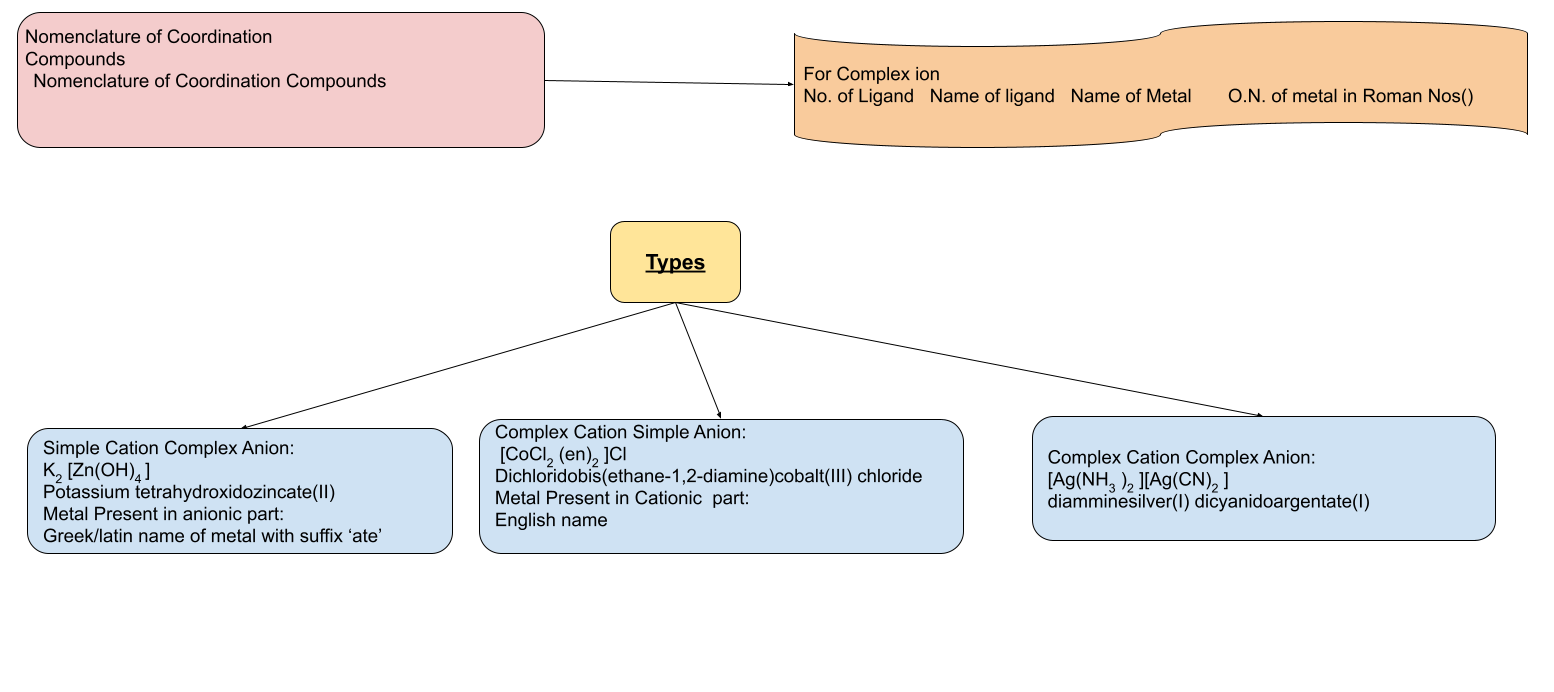
Figure: Flowchart for Naming Coordination Compounds Step-by-Step
3. Naming the Central Metal
The name of the metal depends on the charge of the coordination sphere itself.
Anionic Complex Rule (The "Late" Rule)
If the complex ion is Negative (Anionic), the metal name ends in -ate. Latin names are often used.
- $\text{Fe}$ $\rightarrow$ Ferrate
- $\text{Cu}$ $\rightarrow$ Cuprate
- $\text{Ag}$ $\rightarrow$ Argentate
- $\text{Au}$ $\rightarrow$ Aurate
- $\text{Sn}$ $\rightarrow$ Stannate
- $\text{Pb}$ $\rightarrow$ Plumbate
Note: If the complex is Cationic or Neutral, the metal name remains unchanged (e.g., Iron, Copper).
Special Cases
- Numerical Prefixes: Use di, tri, tetra for simple ligands. Use bis, tris, tetrakis for complex organic ligands (like $en$, $ox$) to avoid confusion.
- Bridging Ligands: If a ligand connects two metal centers, use the prefix $\mu$- (mu) before its name.
- Ambidentate Ligands: Specify the donor atom. e.g., $\text{M-NO}_2$ (Nitrito-N) vs $\text{M-ONO}$ (Nitrito-O).
Explore More Resources
🎯 Coordination Chemistry Masterclass
Learn nomenclature, isomerism, Werner's theory, VBT, CFT and important coordination compound reactions.
Complete Coordination Compounds Chapter →


No comments:
Post a Comment